For most marketing sites, Webflow is the stronger foundation. Sanity earns its place when content needs to live well beyond the website.

It is one of the questions we hear most at the start of a project. A team has outgrown its current site, someone on the engineering side has proposed a headless stack, and someone in marketing is quietly worried about what that will mean for the next campaign launch. Both instincts are reasonable. The answer depends less on the tools than on what the website is actually for.

We have built and maintained production sites on both platforms, so this is not a vendor comparison. It is what that experience has taught us about the choice, and how we help clients make it.

What Sanity does well

Sanity is a genuinely good piece of software, and it is worth being clear about why before talking about trade-offs.

At its core, Sanity treats content as structured data. You define schemas for every content type, and that content can then be delivered through APIs to a website, a mobile app, a product interface, or an AI agent. For organisations publishing the same content across many surfaces, that model is powerful. One source of truth, many destinations.

It also gives developers a great deal of freedom. Sanity Studio is highly customisable, the query language is expressive, and the frontend can be built with whatever framework the team prefers. For a developer-led team building a composable stack, that flexibility is the whole point.

The part of the website Sanity does not build

Headless means exactly that. Sanity manages content, but the website itself, the part your audience actually sees, is a separate project. Someone has to build the frontend, choose and maintain the hosting, wire up previews, and keep the two halves talking to each other.

That is not a flaw. It is the model. But it has a cost that tends to surface after launch rather than before it. A new landing page becomes a ticket. A layout change waits for a sprint. The marketing team owns the words but not the page they sit on.

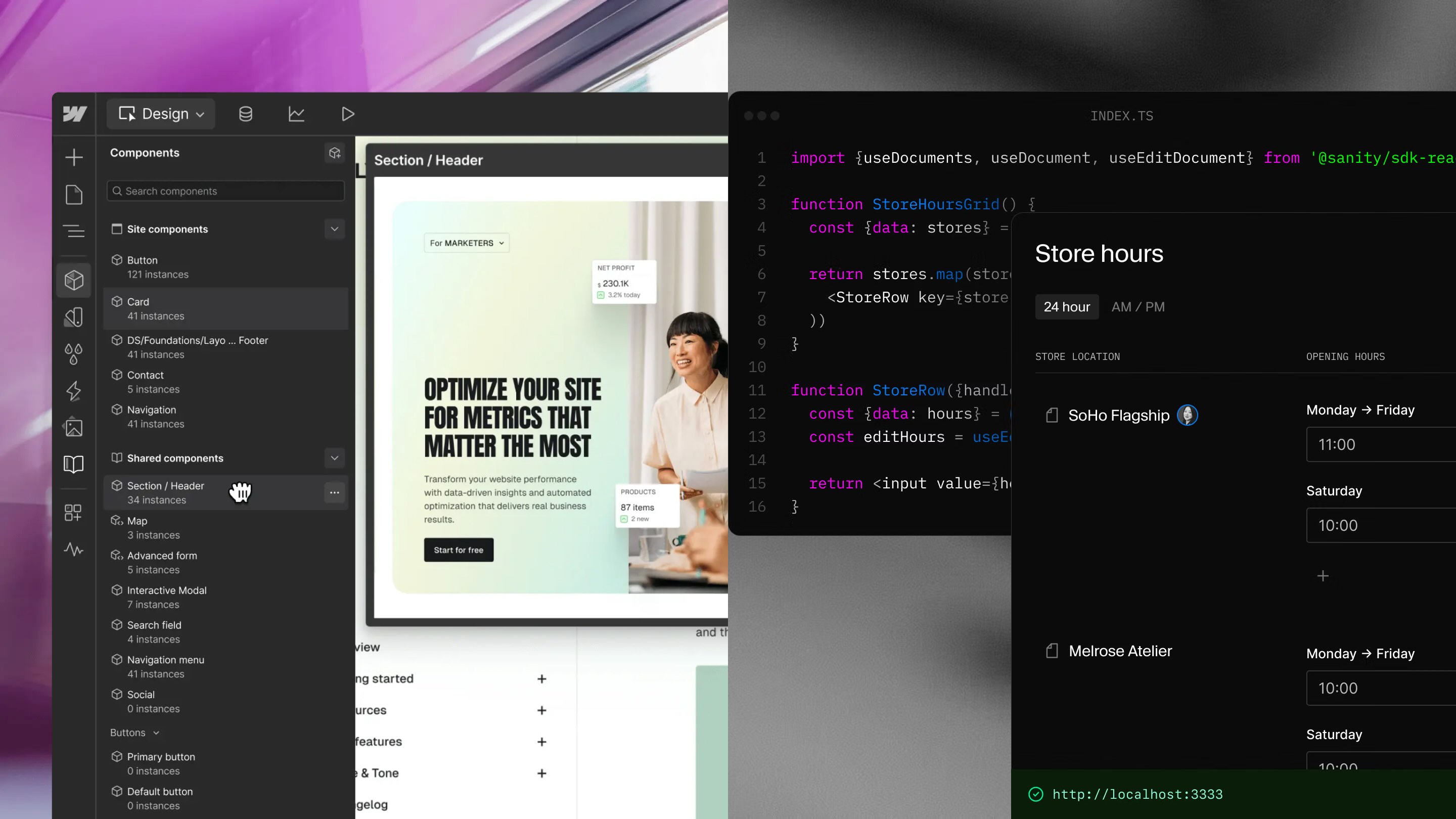
Webflow approaches the problem from the other direction. Visual design, CMS, publishing and managed hosting live in one system, so the people responsible for the site can shape it directly. The content and its presentation stay connected, which is where most of the day-to-day work on a marketing site actually happens.

Autonomy, with guardrails

The usual fear about giving marketers direct control of a site is that the brand will slowly come apart. A spacing value here, an off-palette button there, and eighteen months later nobody recognises the design system.

A well-built Webflow site prevents that by design. Developers and designers define the system: the components, the variables, the CMS structure, the permissions. Marketing and content teams then build pages from those approved parts. They can move quickly because the guardrails are already in place, not because anyone has loosened them.

Sanity can support content-team independence too, but only once developers have configured the Studio, modelled the schemas and set up the workflows. Until then, schemas, APIs and query languages are a real learning curve for non-developers. In practice we find the question is less about whether marketers can edit content, and more about whether they can ship a page.

A website is a growth system, not a content store

Structured content is only one part of what a marketing site needs to do. It also needs to be found, measured, tested and improved, continuously.

With a headless setup, each of those jobs usually means another tool: one for analytics, one for experimentation, one for personalisation, one for localisation, each integrated into a frontend the team also maintains. Every addition is reasonable on its own. Together they become a stack that is harder to change than the site it serves.

Webflow brings much of that work inside the platform. SEO controls, AEO tooling, analytics, optimisation and testing and localisation sit alongside the pages themselves. That matters more now than it did two years ago. Being discoverable increasingly means being cited by AI answers as well as ranked by search engines, and having schema, crawlability and AI-referred traffic data in the same place as the content makes that work far more practical.

Sanity's content model can absolutely support strong SEO. It just depends on the frontend being built to handle it well, and on someone owning that responsibility over time.

The quiet cost of owning two surfaces

The true cost of a platform shows up in year two, not at launch.

A headless build means owning two things that must stay in step: the content backend and the frontend that renders it. The Studio is an application your team configures and upgrades. The frontend has its own framework, dependencies and hosting to keep current. When a major version changes on either side, someone has to plan and fund the upgrade, and on a complex stack that work can take weeks. Teams that defer it end up on older versions, carrying more risk with each release they skip.

There is a design cost too. When components live in code on one side and content models live in a schema on the other, the two drift apart unless someone is actively keeping them aligned. Small inconsistencies accumulate, and the brand gets a little less precise with every campaign.

Webflow ships updates to the platform continuously, so there are no versions to manage and no upgrade projects to schedule. For most marketing teams, that is time and budget better spent on the site itself.

When Sanity is the right call

We would rather recommend the right tool than the one we happen to build with most. Sanity is often the better fit when:

There is also a middle path. Webflow is composable by design, with headless APIs, custom code, React-based Code Components, Webflow Cloud and MCP. Developers can extend the platform and bring their own components onto the canvas, while marketing keeps a visual way to work. For many teams, that covers most of what they were hoping headless would give them.

How we approach the decision at N4

We do not start with the platform. We start with what the site needs to do for the business, and work backwards.

That usually means a few questions asked early. Who will be changing this site every week, and what will they need to change? Where does the content go after it is published? What does the team want to learn from the site, and how quickly do they need to act on it? How much engineering time is genuinely available after launch, not just during the build?

The answers shape the content strategy, the information architecture and the design system long before anyone opens an editor. Once those are clear, the platform choice tends to make itself. When it points to Webflow, we build the system so that marketing can move freely inside it and developers stay in control of the parts that matter. When it points somewhere else, we say so.

The tool is the vehicle. The thinking behind the site is what makes it work.

Frequently asked questions

What is the main difference between Webflow and Sanity?

Sanity is a developer-first platform for structured content that can be delivered anywhere. Webflow is a visual web platform that combines design, CMS, hosting, SEO, AEO, analytics and testing in one place. One manages content; the other manages the whole website.

Can our marketing team manage the site themselves in Webflow?

Yes. Once the design system and CMS are set up, marketing and content teams can publish pages and update content using approved components, without developer involvement for everyday changes.

Is Astro with Sanity a good alternative?

It can be a strong code-first setup for teams that want to own the frontend and the content backend separately. The trade-off is that your team also owns the integration between them, and keeping both in sync becomes ongoing work.

Can developers still extend Webflow?

Yes. Webflow supports APIs, custom code, React-based Code Components, Webflow Cloud and MCP, so developers can integrate and extend the platform without forcing every marketing workflow into code.

Which is better for SEO and AEO?

For marketing sites, Webflow gives teams more native control: metadata, schema, sitemaps, crawlability and AI-referred traffic insights all live in the platform. Sanity can support strong SEO when the frontend is built and maintained with that in mind.

Choosing with clarity

Neither platform is the wrong answer in general. Each is the wrong answer for some teams. The useful question is not which tool is more powerful, but which one lets your team do its best work on the site, week after week, without the platform getting in the way.

If you are weighing Webflow against Sanity, or a headless stack against a visual one, we are happy to talk it through. We will start with your goals, not our preferences.
Research
Research

July 1, 2026

Webflow vs Sanity: What Building on Both Has Taught Us

Webflow or Sanity for your marketing site? N4 has built on both. An honest look at where each one wins, and how to choose for your team.

For most marketing sites, Webflow is the stronger foundation. Sanity earns its place when content needs to live well beyond the website.

It is one of the questions we hear most at the start of a project. A team has outgrown its current site, someone on the engineering side has proposed a headless stack, and someone in marketing is quietly worried about what that will mean for the next campaign launch. Both instincts are reasonable. The answer depends less on the tools than on what the website is actually for.

We have built and maintained production sites on both platforms, so this is not a vendor comparison. It is what that experience has taught us about the choice, and how we help clients make it.

What Sanity does well

Sanity is a genuinely good piece of software, and it is worth being clear about why before talking about trade-offs.

At its core, Sanity treats content as structured data. You define schemas for every content type, and that content can then be delivered through APIs to a website, a mobile app, a product interface, or an AI agent. For organisations publishing the same content across many surfaces, that model is powerful. One source of truth, many destinations.

It also gives developers a great deal of freedom. Sanity Studio is highly customisable, the query language is expressive, and the frontend can be built with whatever framework the team prefers. For a developer-led team building a composable stack, that flexibility is the whole point.

The part of the website Sanity does not build

Headless means exactly that. Sanity manages content, but the website itself, the part your audience actually sees, is a separate project. Someone has to build the frontend, choose and maintain the hosting, wire up previews, and keep the two halves talking to each other.

That is not a flaw. It is the model. But it has a cost that tends to surface after launch rather than before it. A new landing page becomes a ticket. A layout change waits for a sprint. The marketing team owns the words but not the page they sit on.

Webflow approaches the problem from the other direction. Visual design, CMS, publishing and managed hosting live in one system, so the people responsible for the site can shape it directly. The content and its presentation stay connected, which is where most of the day-to-day work on a marketing site actually happens.

Autonomy, with guardrails

The usual fear about giving marketers direct control of a site is that the brand will slowly come apart. A spacing value here, an off-palette button there, and eighteen months later nobody recognises the design system.

A well-built Webflow site prevents that by design. Developers and designers define the system: the components, the variables, the CMS structure, the permissions. Marketing and content teams then build pages from those approved parts. They can move quickly because the guardrails are already in place, not because anyone has loosened them.

Sanity can support content-team independence too, but only once developers have configured the Studio, modelled the schemas and set up the workflows. Until then, schemas, APIs and query languages are a real learning curve for non-developers. In practice we find the question is less about whether marketers can edit content, and more about whether they can ship a page.

A website is a growth system, not a content store

Structured content is only one part of what a marketing site needs to do. It also needs to be found, measured, tested and improved, continuously.

With a headless setup, each of those jobs usually means another tool: one for analytics, one for experimentation, one for personalisation, one for localisation, each integrated into a frontend the team also maintains. Every addition is reasonable on its own. Together they become a stack that is harder to change than the site it serves.

Webflow brings much of that work inside the platform. SEO controls, AEO tooling, analytics, optimisation and testing and localisation sit alongside the pages themselves. That matters more now than it did two years ago. Being discoverable increasingly means being cited by AI answers as well as ranked by search engines, and having schema, crawlability and AI-referred traffic data in the same place as the content makes that work far more practical.

Sanity's content model can absolutely support strong SEO. It just depends on the frontend being built to handle it well, and on someone owning that responsibility over time.

The quiet cost of owning two surfaces

The true cost of a platform shows up in year two, not at launch.

A headless build means owning two things that must stay in step: the content backend and the frontend that renders it. The Studio is an application your team configures and upgrades. The frontend has its own framework, dependencies and hosting to keep current. When a major version changes on either side, someone has to plan and fund the upgrade, and on a complex stack that work can take weeks. Teams that defer it end up on older versions, carrying more risk with each release they skip.

There is a design cost too. When components live in code on one side and content models live in a schema on the other, the two drift apart unless someone is actively keeping them aligned. Small inconsistencies accumulate, and the brand gets a little less precise with every campaign.

Webflow ships updates to the platform continuously, so there are no versions to manage and no upgrade projects to schedule. For most marketing teams, that is time and budget better spent on the site itself.

When Sanity is the right call

We would rather recommend the right tool than the one we happen to build with most. Sanity is often the better fit when:

  • The same content needs to power a website, native apps, in-product surfaces or AI agents, and the website is one destination among many.
  • You have an in-house engineering team that wants to own the frontend and has the capacity to maintain it.
  • Your content model is unusually complex, with deep relationships and custom editorial workflows that go beyond a marketing site.
  • The site is closer to a product than a marketing channel.

There is also a middle path. Webflow is composable by design, with headless APIs, custom code, React-based Code Components, Webflow Cloud and MCP. Developers can extend the platform and bring their own components onto the canvas, while marketing keeps a visual way to work. For many teams, that covers most of what they were hoping headless would give them.

How we approach the decision at N4

We do not start with the platform. We start with what the site needs to do for the business, and work backwards.

That usually means a few questions asked early. Who will be changing this site every week, and what will they need to change? Where does the content go after it is published? What does the team want to learn from the site, and how quickly do they need to act on it? How much engineering time is genuinely available after launch, not just during the build?

The answers shape the content strategy, the information architecture and the design system long before anyone opens an editor. Once those are clear, the platform choice tends to make itself. When it points to Webflow, we build the system so that marketing can move freely inside it and developers stay in control of the parts that matter. When it points somewhere else, we say so.

The tool is the vehicle. The thinking behind the site is what makes it work.

Frequently asked questions

What is the main difference between Webflow and Sanity?

Sanity is a developer-first platform for structured content that can be delivered anywhere. Webflow is a visual web platform that combines design, CMS, hosting, SEO, AEO, analytics and testing in one place. One manages content; the other manages the whole website.

Can our marketing team manage the site themselves in Webflow?

Yes. Once the design system and CMS are set up, marketing and content teams can publish pages and update content using approved components, without developer involvement for everyday changes.

Is Astro with Sanity a good alternative?

It can be a strong code-first setup for teams that want to own the frontend and the content backend separately. The trade-off is that your team also owns the integration between them, and keeping both in sync becomes ongoing work.

Can developers still extend Webflow?

Yes. Webflow supports APIs, custom code, React-based Code Components, Webflow Cloud and MCP, so developers can integrate and extend the platform without forcing every marketing workflow into code.

Which is better for SEO and AEO?

For marketing sites, Webflow gives teams more native control: metadata, schema, sitemaps, crawlability and AI-referred traffic insights all live in the platform. Sanity can support strong SEO when the frontend is built and maintained with that in mind.

Choosing with clarity

Neither platform is the wrong answer in general. Each is the wrong answer for some teams. The useful question is not which tool is more powerful, but which one lets your team do its best work on the site, week after week, without the platform getting in the way.

If you are weighing Webflow against Sanity, or a headless stack against a visual one, we are happy to talk it through. We will start with your goals, not our preferences.
Written by

Jonathan Cook

Jonathan Cook

Founder, N4

Tags

SHARE

https://www.n4.studio/blog/webflow-vs-sanity

Launch a website your audience will love — at speed.