Few enterprise conversations start with "should we leave AEM?" They start with a quieter frustration: a campaign page that took six weeks, a localisation backlog, a renewal quote that made finance wince and took budget away from more important things. Then comes the question we hear most often. Is there anything else that can actually handle a site our size?

Both instincts are reasonable. AEM was built for the largest organisations in the world, and for a long time there was no credible alternative that could carry the same load. Leaving it felt like stepping off a ship with no life raft in sight.

We have been building for over ten years, and in that time we have worked with almost every CMS you could name, building on some and migrating clients off many more. Webflow has been in our toolkit for that whole decade, and over the past five years its enterprise capability has grown to rival the best. We have grown alongside it, and a significant part of our work is now moving large organisations from AEM to Webflow Enterprise.

Recent migrations include large healthcare providers and publishing organisations, and we are in conversations with several more household names doing the same. This piece is what those projects have taught us about where each platform wins.
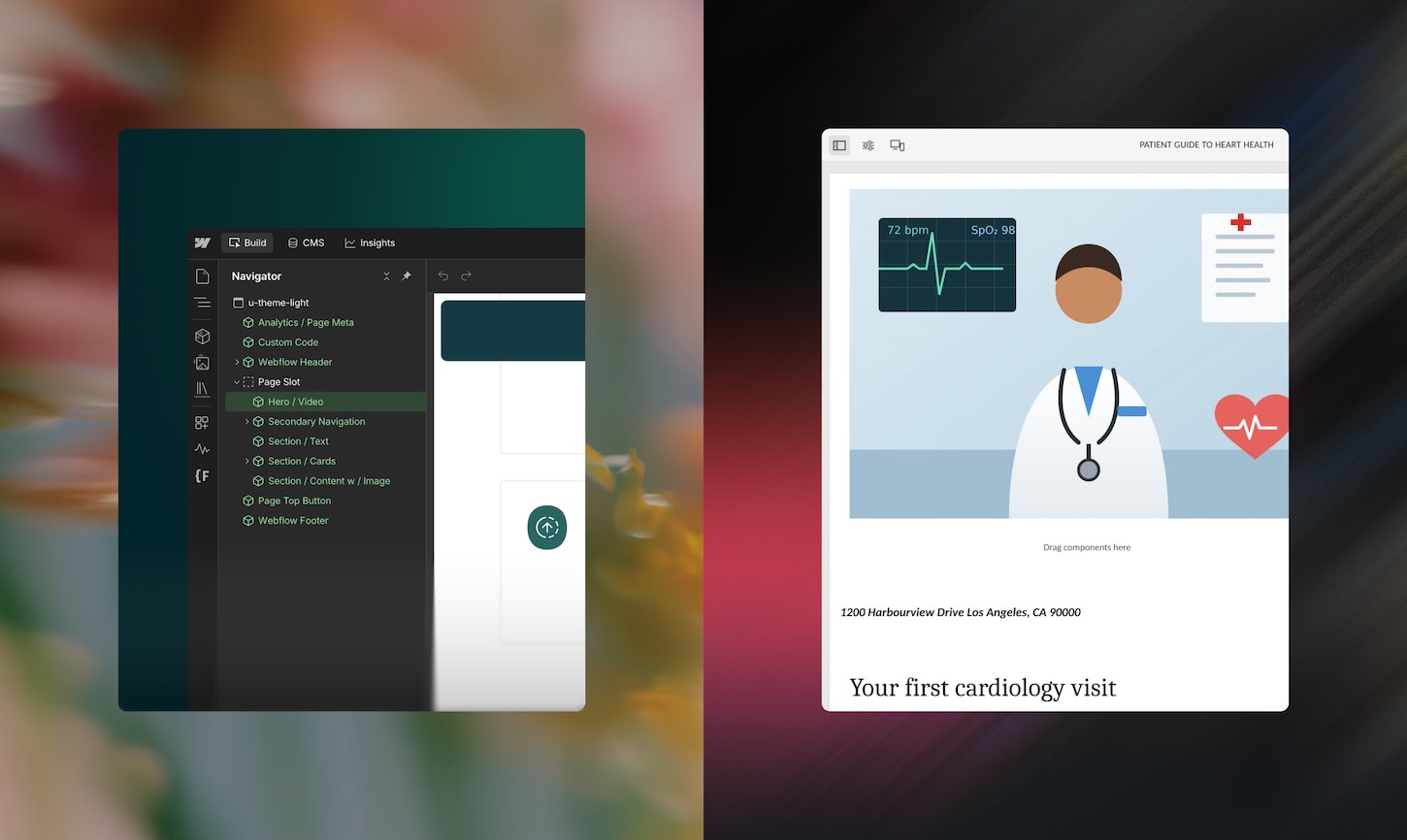
Webflow (Left), AEM (Right)

What AEM does well

AEM is not a CMS in the ordinary sense. It is the content layer of a whole suite, and in the right organisation that is exactly its strength.

Its asset management is among the most capable anywhere. Teams producing thousands of images, videos and renditions a month, with rights, expiry and approval rules attached, get real value from AEM Assets.

Its connection to the rest of Adobe Experience Cloud is deep. When Analytics, Target and Adobe's customer data platform already sit at the centre of a business, AEM can use that data natively to shape what each visitor sees.

It also handles more than marketing pages. Authenticated portals, member areas and complex application logic are all within reach, backed by a Java stack that a capable engineering team can extend in almost any direction. Governance is mature too, with granular workflows built for heavily regulated, multi-brand organisations.

That is not a weakness to explain away. For some organisations, it is the right model.

What all that power asks of you

The trade-off is that AEM's capability has to be built, staffed and paid for before marketing sees any of it.

Implementations typically run for many months, often years, and lean on specialist AEM developers, a scarce and expensive skill set. Components are engineered rather than designed, so every new layout becomes a development request. Analytics, testing and personalisation each live in a separate Adobe product, with its own licence and its own integration work.

The result we see again and again is a site that could do almost anything, run by a team that can change almost nothing without a ticket. The platform is enterprise grade. The day-to-day experience of using it often is not.

Autonomy, with guardrails

The biggest change our AEM clients feel after migrating is not a feature. It is who gets to ship.

In Webflow, marketers build and publish pages from approved components, in the browser, without a sprint. Roles, permissions, staging and publishing approvals are built in, so autonomy does not mean a free-for-all. The brand stays intact because the system is designed to keep it intact.

For multi-brand and multi-site organisations, this is where design thinking does the heavy lifting. We build shared component libraries that deploy across sites, with room for each brand's own expression, so a regional team can launch a campaign page that looks unmistakably theirs and still belongs to the whole.

"Moving off AEM is not about giving marketing a blank canvas. It is about giving them a system they can trust. When the components are designed well, a new page is a quick decision, not a negotiation with the brand team."

- Adam Bradley, Design Lead, N4
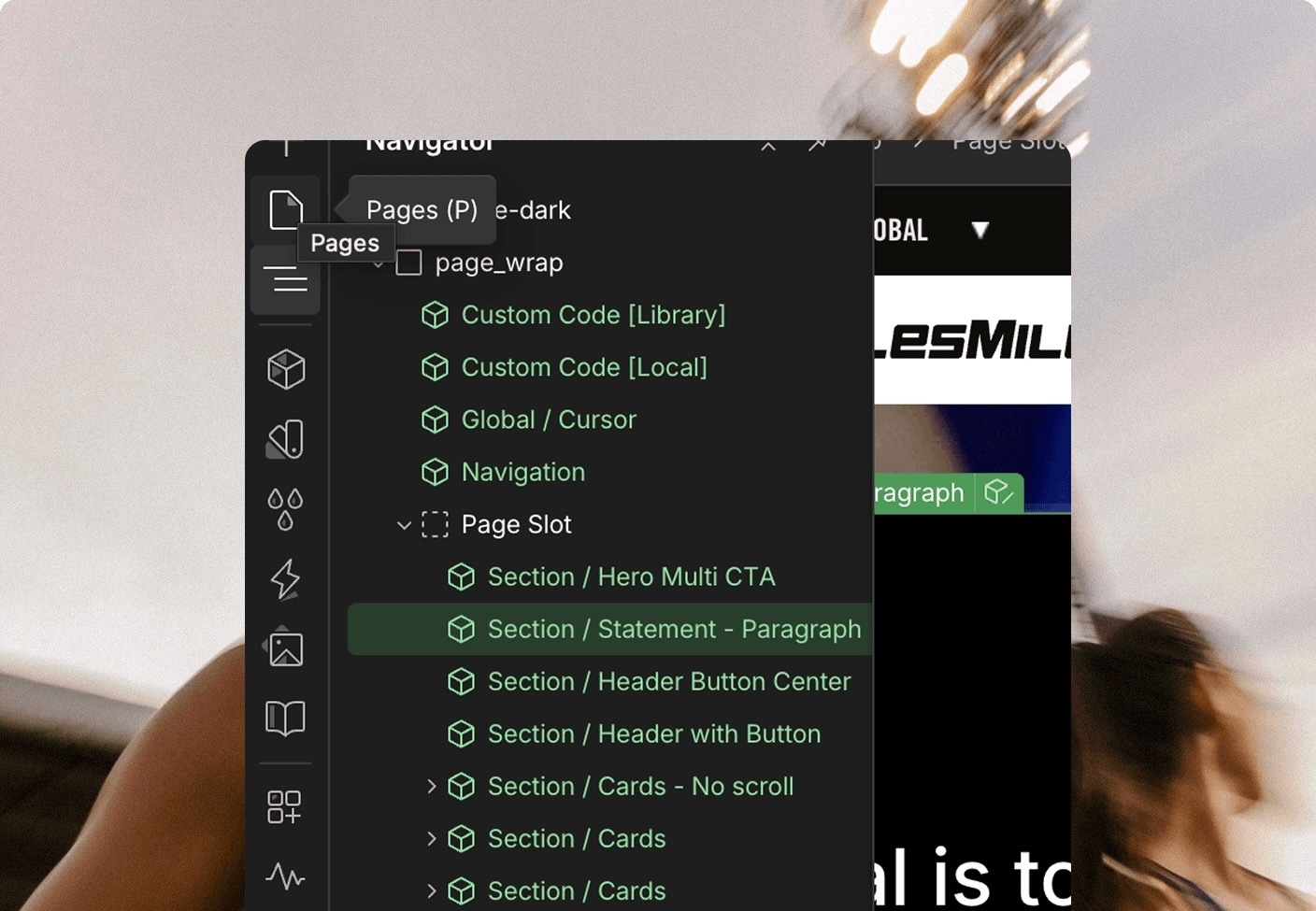
Structured component system

A website is a growth system, not a content store

The sites we migrate from AEM are rarely short on content. What they lack is the ability to act on it quickly.

In AEM, testing, personalisation and analytics typically mean adding and integrating more Adobe products. Webflow brings A/B testing, personalisation, analytics and localisation into the same platform the team already builds in. Optimising a page becomes part of publishing it, not a separate project.

Search is changing just as fast. Answer engines now shape how buyers find brands, and Webflow ships AEO tooling, structured content controls and clean, fast markup as part of the platform. It has also moved early on MCP, so AI agents can work directly with a site's content and structure. Teams on Webflow get these as they arrive, rather than waiting for an upgrade cycle.

Migrating does not mean abandoning what works, either. For most clients we kept Adobe Analytics in place, so reporting carried straight across without a break in the data.
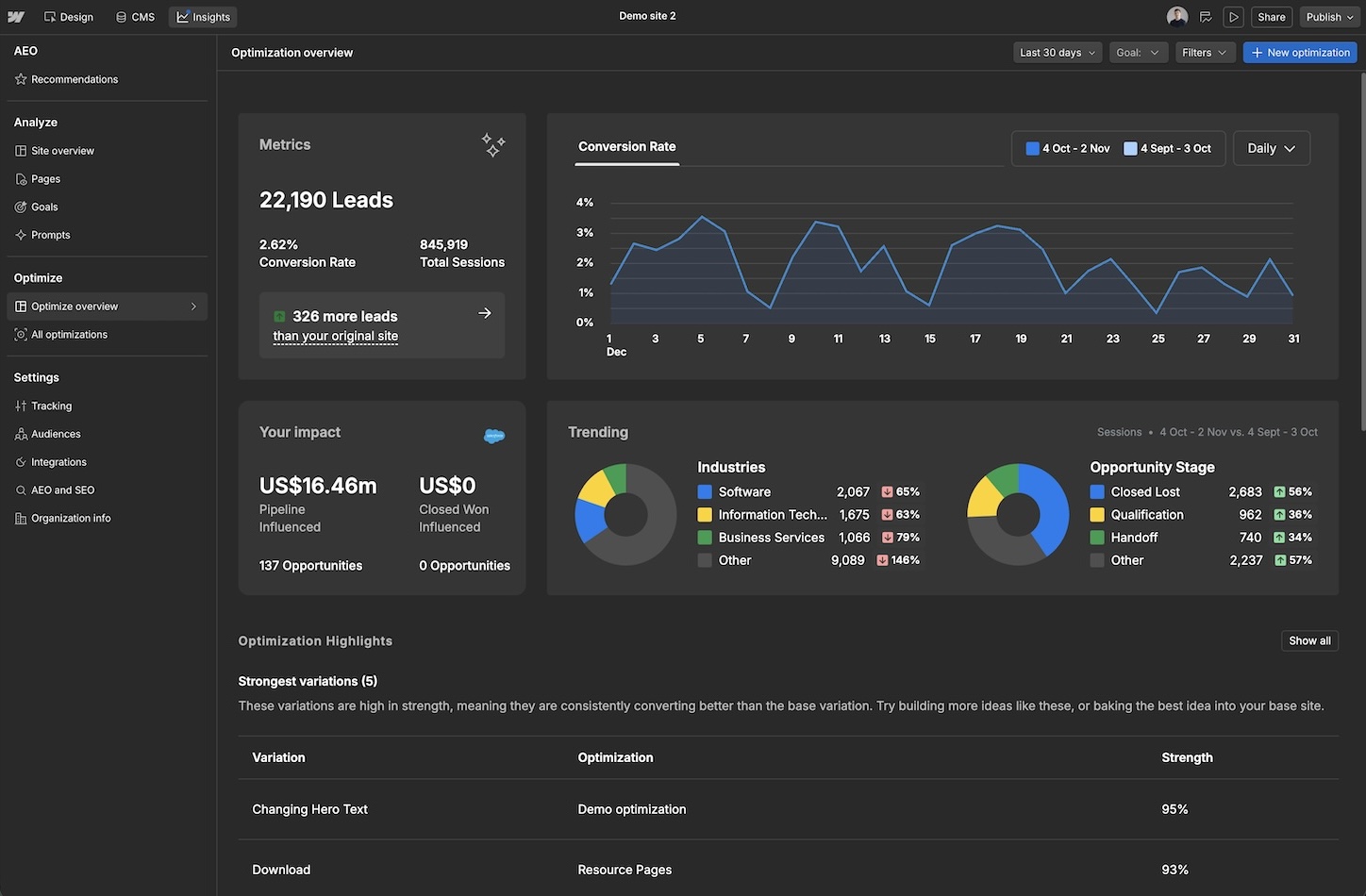
Webflow Optimize with Salesforce Integration

The quiet cost of running AEM

It is no secret that AEM carries the heaviest price tag in the category. What surprises clients is how much of the cost sits outside the licence.

There are the specialist developers needed for routine changes, the agency retainers to keep the platform healthy, the separate Adobe products for testing and personalisation, and the upgrade and maintenance work that never quite ends. In the migrations we have scoped, the total cost of running AEM has often been five times (500%+) or more that of Webflow Enterprise for the same marketing site.

The saving is not only on the invoice. When marketers stop raising tickets for every page, development budgets move from upkeep to genuinely new work. That is where the difference compounds: in year two and year three, not at launch.

"Most of the AEM estates we review were bought for a scale of ambition the marketing site never needed. Once you separate what the business genuinely relies on from what it is simply paying for, the case usually makes itself."

- Alexandria Hurly, Managing Director, N4

When AEM is the right call

We would rather recommend the right tool than the one we happen to build with most. AEM is often the better fit when:

Outside those cases, the gap has closed. Webflow is now trusted by organisations like Dropbox, Spotify, DocuSign and The New York Times, among many others. A recent migration we completed for a major American multinational publisher shows how far. The site runs across 28 locales, with more than 100,000+ localized static and CMS pages and over 150 authors. It needed headless components to feed the publisher's ecommerce systems, an Osano consent integration and Adobe Analytics retained throughout. That is about as demanding as a marketing site gets, and Webflow Enterprise carried all of it.

Another client, a major nonprofit academic healthcare system in California, followed a similar path: a large, high-stakes organisation that wanted its teams moving faster without giving up the governance it depended on.

"That publisher migration was a real test of what Webflow Enterprise can take on. Twenty-eight locales, ecommerce systems pulling from headless components, analytics that had to keep running. The team now ships in days what used to take weeks."

- Alex Rankin, Technical Lead, N4

How we approach the decision at N4

We start with what the website is for, not which platform it runs on. Discovery maps what the business genuinely uses in AEM today, what it pays for but does not use, and what its teams are waiting on. The platform choice follows from that.

When the answer is Webflow, the fear is usually the migration itself: years of content, thousands of pages, dozens of teams. That is where a honed process matters more than any feature list. Ours rests on a few principles.

Frequently asked questions

Q: What is the main difference between Webflow and Adobe Experience Manager?

A: AEM is the content layer of Adobe's wider experience suite, built for deep integration and heavy engineering. Webflow is a visual, all-in-one platform where marketing can design, publish, localize and optimize directly, with developers extending it where needed. If a headless option is also on your shortlist, our Webflow vs Sanity piece covers that trade-off.

Q: Is Webflow a realistic alternative to AEM for a large enterprise?

A: For most marketing sites, yes. Webflow Enterprise offers the security, uptime commitments, roles, staging and localisation large organisations need. One global publisher we migrated now runs 28 locales and more than 100,000 localized pages on it.

Q: How long does an AEM to Webflow migration take?

A: In our experience, three to six months to final launch for most enterprise sites. Staged releases mean teams are often publishing in Webflow well before that.

Q: Can we keep Adobe Analytics and other tools if we move to Webflow?

A: Yes. Webflow integrates with the tools a business already relies on. On a recent migration for a multinational publisher, we kept Adobe Analytics and integrated Osano for consent management.

Q: Which is better for SEO and AEO?

A: Both can perform well, but Webflow builds the essentials into the platform: clean markup, fast hosting, structured content and native AEO tooling. Teams can act on search insight the same day, without waiting on a development cycle.

Choosing with clarity

AEM is not the wrong tool. For organisations whose website is one surface of a deep Adobe estate, it remains a defendable choice. But for most enterprise marketing sites, it was simply the only option big enough at the time. That is no longer true.

We will be honest about which side of that line you sit on, even if the answer is to stay. If you are weighing the move, talk to us.
Start a conversation

Articles
Articles

July 29, 2026

Webflow vs AEM: What Enterprise Migrations Taught Us

Webflow Enterprise or AEM? N4 has moved global enterprises from Adobe Experience Manager to Webflow Enterprise. An honest look at where each wins.

Table of contents
00 Min read

Summary

Having moved some of the world's most complex marketing sites from AEM to Webflow, we find the real question is not which platform is more powerful, but how much of that power your website actually uses.

  • Choose Webflow when marketing needs to launch, localize and test at speed, with enterprise governance and a fraction of the running cost.
  • Choose AEM when the website is one surface of a deep Adobe estate: authenticated portals, heavy asset operations and personalisation tied to Adobe's data platform.
  • AEM's capability comes with the heaviest licence, implementation and developer bill in the category, and most marketing sites pay for far more than they use.

For the majority of enterprise marketing sites, Webflow Enterprise now matches AEM where it matters and moves faster, while AEM still earns its place when the site behaves like a product.

Note: This is not a feature-by-feature comparison. There are plenty of those already around the web. It is a human view, drawn from the many teams we have worked with and spoken to over the past ten years.

Few enterprise conversations start with "should we leave AEM?" They start with a quieter frustration: a campaign page that took six weeks, a localisation backlog, a renewal quote that made finance wince and took budget away from more important things. Then comes the question we hear most often. Is there anything else that can actually handle a site our size?

Both instincts are reasonable. AEM was built for the largest organisations in the world, and for a long time there was no credible alternative that could carry the same load. Leaving it felt like stepping off a ship with no life raft in sight.

We have been building for over ten years, and in that time we have worked with almost every CMS you could name, building on some and migrating clients off many more. Webflow has been in our toolkit for that whole decade, and over the past five years its enterprise capability has grown to rival the best. We have grown alongside it, and a significant part of our work is now moving large organisations from AEM to Webflow Enterprise.

Recent migrations include large healthcare providers and publishing organisations, and we are in conversations with several more household names doing the same. This piece is what those projects have taught us about where each platform wins.

Webflow (Left), AEM (Right)

What AEM does well

AEM is not a CMS in the ordinary sense. It is the content layer of a whole suite, and in the right organisation that is exactly its strength.

Its asset management is among the most capable anywhere. Teams producing thousands of images, videos and renditions a month, with rights, expiry and approval rules attached, get real value from AEM Assets.

Its connection to the rest of Adobe Experience Cloud is deep. When Analytics, Target and Adobe's customer data platform already sit at the centre of a business, AEM can use that data natively to shape what each visitor sees.

It also handles more than marketing pages. Authenticated portals, member areas and complex application logic are all within reach, backed by a Java stack that a capable engineering team can extend in almost any direction. Governance is mature too, with granular workflows built for heavily regulated, multi-brand organisations.

That is not a weakness to explain away. For some organisations, it is the right model.

What all that power asks of you

The trade-off is that AEM's capability has to be built, staffed and paid for before marketing sees any of it.

Implementations typically run for many months, often years, and lean on specialist AEM developers, a scarce and expensive skill set. Components are engineered rather than designed, so every new layout becomes a development request. Analytics, testing and personalisation each live in a separate Adobe product, with its own licence and its own integration work.

The result we see again and again is a site that could do almost anything, run by a team that can change almost nothing without a ticket. The platform is enterprise grade. The day-to-day experience of using it often is not.

Autonomy, with guardrails

The biggest change our AEM clients feel after migrating is not a feature. It is who gets to ship.

In Webflow, marketers build and publish pages from approved components, in the browser, without a sprint. Roles, permissions, staging and publishing approvals are built in, so autonomy does not mean a free-for-all. The brand stays intact because the system is designed to keep it intact.

For multi-brand and multi-site organisations, this is where design thinking does the heavy lifting. We build shared component libraries that deploy across sites, with room for each brand's own expression, so a regional team can launch a campaign page that looks unmistakably theirs and still belongs to the whole.

"Moving off AEM is not about giving marketing a blank canvas. It is about giving them a system they can trust. When the components are designed well, a new page is a quick decision, not a negotiation with the brand team."

- Adam Bradley, Design Lead, N4

Structured component system

A website is a growth system, not a content store

The sites we migrate from AEM are rarely short on content. What they lack is the ability to act on it quickly.

In AEM, testing, personalisation and analytics typically mean adding and integrating more Adobe products. Webflow brings A/B testing, personalisation, analytics and localisation into the same platform the team already builds in. Optimising a page becomes part of publishing it, not a separate project.

Search is changing just as fast. Answer engines now shape how buyers find brands, and Webflow ships AEO tooling, structured content controls and clean, fast markup as part of the platform. It has also moved early on MCP, so AI agents can work directly with a site's content and structure. Teams on Webflow get these as they arrive, rather than waiting for an upgrade cycle.

Migrating does not mean abandoning what works, either. For most clients we kept Adobe Analytics in place, so reporting carried straight across without a break in the data.

Webflow Optimize with Salesforce Integration

The quiet cost of running AEM

It is no secret that AEM carries the heaviest price tag in the category. What surprises clients is how much of the cost sits outside the licence.

There are the specialist developers needed for routine changes, the agency retainers to keep the platform healthy, the separate Adobe products for testing and personalisation, and the upgrade and maintenance work that never quite ends. In the migrations we have scoped, the total cost of running AEM has often been five times (500%+) or more that of Webflow Enterprise for the same marketing site.

The saving is not only on the invoice. When marketers stop raising tickets for every page, development budgets move from upkeep to genuinely new work. That is where the difference compounds: in year two and year three, not at launch.

"Most of the AEM estates we review were bought for a scale of ambition the marketing site never needed. Once you separate what the business genuinely relies on from what it is simply paying for, the case usually makes itself."

- Alexandria Hurly, Managing Director, N4

When AEM is the right call

We would rather recommend the right tool than the one we happen to build with most. AEM is often the better fit when:

  • The marketing website is one part of a large, integrated Adobe Experience Cloud investment that the business actively relies on.
  • The site is closer to an application: authenticated portals, transactional flows or deep custom logic that goes well beyond marketing.

Outside those cases, the gap has closed. Webflow is now trusted by organisations like Dropbox, Spotify, DocuSign and The New York Times, among many others. A recent migration we completed for a major American multinational publisher shows how far. The site runs across 28 locales, with more than 100,000+ localized static and CMS pages and over 150 authors. It needed headless components to feed the publisher's ecommerce systems, an Osano consent integration and Adobe Analytics retained throughout. That is about as demanding as a marketing site gets, and Webflow Enterprise carried all of it.

Another client, a major nonprofit academic healthcare system in California, followed a similar path: a large, high-stakes organisation that wanted its teams moving faster without giving up the governance it depended on.

"That publisher migration was a real test of what Webflow Enterprise can take on. Twenty-eight locales, ecommerce systems pulling from headless components, analytics that had to keep running. The team now ships in days what used to take weeks."

- Alex Rankin, Technical Lead, N4

How we approach the decision at N4

We start with what the website is for, not which platform it runs on. Discovery maps what the business genuinely uses in AEM today, what it pays for but does not use, and what its teams are waiting on. The platform choice follows from that.

When the answer is Webflow, the fear is usually the migration itself: years of content, thousands of pages, dozens of teams. That is where a honed process matters more than any feature list. Ours rests on a few principles.

  • Structure the content properly. AEM content is often loosely structured, locked inside components and page templates. Our own migration tooling converts that unstructured content into clean, structured CMS data, so it arrives in Webflow ready to reuse rather than copied page by page.
  • Build one system for many sites. Our shared component library approach lets a single design system deploy across multiple sites and brands, with customisation where each brand needs it.
  • Launch in stages, not in one leap. We go live first with low-risk pages to prove the pipeline end to end. High-priority pages come next, so teams are working in Webflow and moving faster early in the project. The rest follows in waves until the final cutover, which typically lands in three to six months rather than the years many teams expect.
  • Bring the team in early. Training starts as early as week four, and we document the build in Confluence every week, so knowledge sits with the client rather than with us.

Frequently asked questions

Q: What is the main difference between Webflow and Adobe Experience Manager?

A: AEM is the content layer of Adobe's wider experience suite, built for deep integration and heavy engineering. Webflow is a visual, all-in-one platform where marketing can design, publish, localize and optimize directly, with developers extending it where needed. If a headless option is also on your shortlist, our Webflow vs Sanity piece covers that trade-off.

Q: Is Webflow a realistic alternative to AEM for a large enterprise?

A: For most marketing sites, yes. Webflow Enterprise offers the security, uptime commitments, roles, staging and localisation large organisations need. One global publisher we migrated now runs 28 locales and more than 100,000 localized pages on it.

Q: How long does an AEM to Webflow migration take?

A: In our experience, three to six months to final launch for most enterprise sites. Staged releases mean teams are often publishing in Webflow well before that.

Q: Can we keep Adobe Analytics and other tools if we move to Webflow?

A: Yes. Webflow integrates with the tools a business already relies on. On a recent migration for a multinational publisher, we kept Adobe Analytics and integrated Osano for consent management.

Q: Which is better for SEO and AEO?

A: Both can perform well, but Webflow builds the essentials into the platform: clean markup, fast hosting, structured content and native AEO tooling. Teams can act on search insight the same day, without waiting on a development cycle.

Choosing with clarity

AEM is not the wrong tool. For organisations whose website is one surface of a deep Adobe estate, it remains a defendable choice. But for most enterprise marketing sites, it was simply the only option big enough at the time. That is no longer true.

We will be honest about which side of that line you sit on, even if the answer is to stay. If you are weighing the move, talk to us.

Start a conversation

Written by

Jonathan Cook

Jonathan Cook

Founder, N4

Tags

SHARE

https://www.n4.studio/blog/webflow-vs-aem

Launch a website your audience will love — at speed.