Search has changed. Your strategy needs to catch up.

Enterprise SEO in 2025 is not the same discipline it was five years ago. Google's AI Overviews, Perplexity, ChatGPT Search, and a growing number of AI-powered assistants are now surfacing answers directly - without a click. The brands appearing in those answers are not getting there by accident.

This is Answer Engine Optimisation (AEO): the practice of structuring content so that AI systems can extract, trust, and cite it as an authoritative response. For enterprise teams, it changes the brief. You are no longer optimising purely for a position on a results page. You are optimising to be the answer.

Below is the updated checklist. Each point applies to both traditional search and AEO, with notes on where Webflow Enterprise gives your team a structural advantage.

01. Establish Topical Authority Through Content Architecture

AI answer engines do not cherry-pick individual pages at random. They identify domains with comprehensive, coherent coverage of a subject and treat them as authoritative sources. This is why content clusters - a pillar page supported by a network of related articles - remain one of the most important structural investments an enterprise can make.

For AEO specifically, your pillar content needs to directly answer the questions your audience is typing into AI assistants. Think in questions, not just keywords. Structure H2s and H3s as explicit questions. Provide direct, factual answers in the first paragraph beneath each heading before expanding.

Webflow advantage: Webflow's CMS allows enterprise teams to build and manage content clusters at scale - with collection references linking related articles, author profiles, and categories. Your editors can maintain structural consistency across hundreds of posts without touching code, and your developers can enforce the linking architecture that holds the cluster together.

02. Implement Schema Markup Systematically

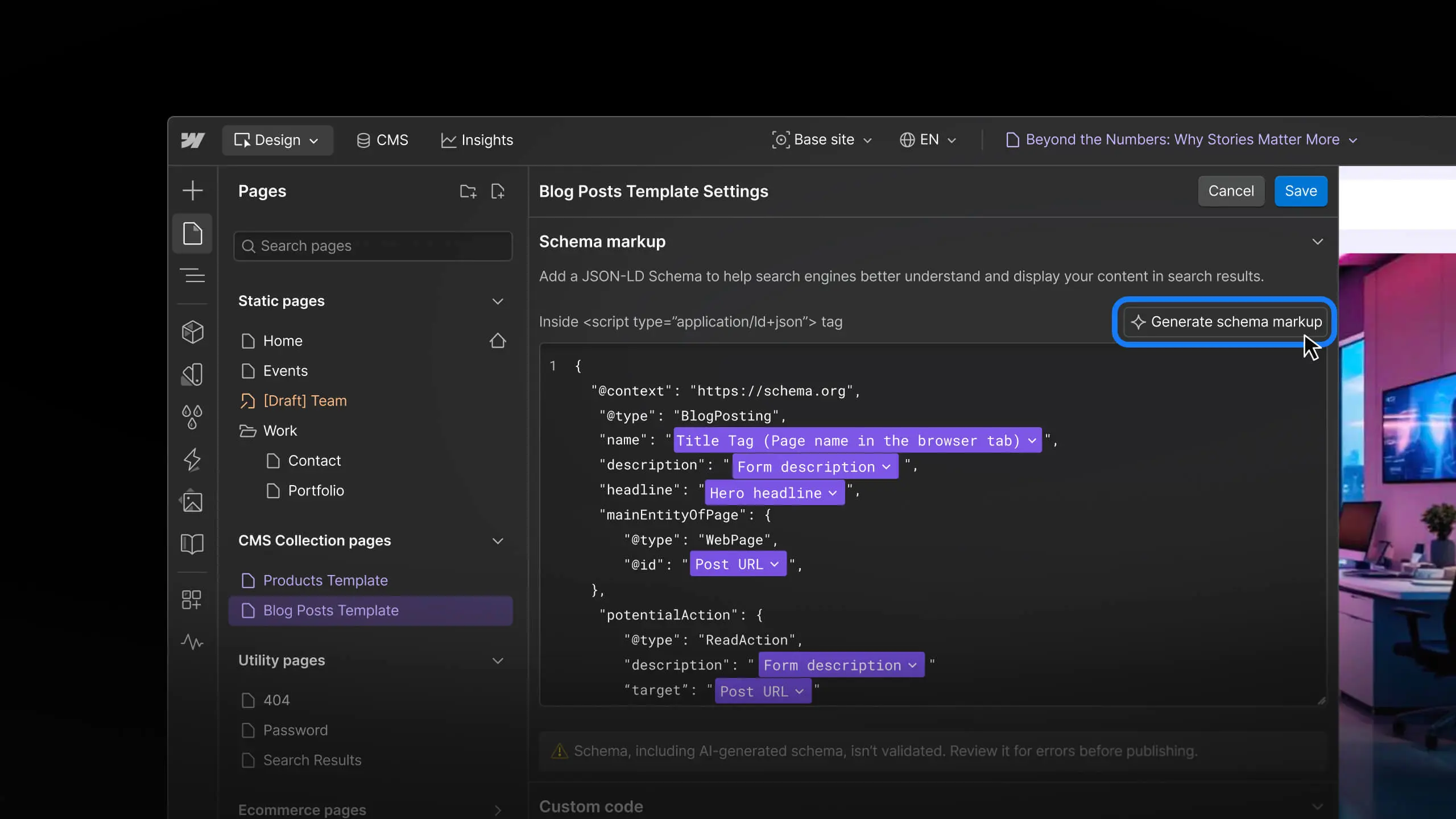
Structured data is one of the clearest signals you can send to both traditional search engines and AI answer engines. Article schema, FAQ schema, HowTo schema, Organisation schema - each tells an AI exactly how to interpret and categorise your content.

For enterprise sites, the challenge is not knowing what schema to implement. It is implementing it consistently across thousands of pages without introducing errors. This requires a system, not a one-time sprint.

Webflow advantage: Webflow Enterprise supports custom code embeds and CMS-driven dynamic attributes, which means schema can be generated programmatically from your content fields rather than added manually page by page. Your team defines the schema template once; it scales automatically across every new piece of content published.
03. Optimise for Search Intent - and AI Query Patterns

Search intent has always mattered. But AI assistants have introduced a new layer: conversational, multi-part queries that expect a direct, synthesised answer rather than a list of links to explore.

Enterprise teams should now be mapping content to three overlapping layers of intent: traditional search intent (informational, navigational, transactional, commercial), AI query patterns (full-sentence questions, comparison queries, definitional queries), and buyer journey stage (awareness through to decision). Content that satisfies all three layers is the content that gets cited.

A practical starting point: pull your most valuable commercial keywords and write a short, direct paragraph answering the most obvious question behind each one. Place it near the top of the page. AI systems are trained to surface direct answers, and this pattern dramatically improves your visibility in AI-generated results.

04. Treat Core Web Vitals as a Non-Negotiable

Page experience signals - Largest Contentful Paint, Interaction to Next Paint, Cumulative Layout Shift - remain part of Google's ranking framework. For enterprise sites, poor Core Web Vitals often come down to bloated front-end stacks, unoptimised images, and render-blocking third-party scripts rather than content issues.

Webflow advantage: Webflow generates clean, standards-compliant HTML and CSS without the theme overhead common in CMS platforms like WordPress. Images served through Webflow's CDN are automatically compressed, and the platform's asset pipeline reduces the most common sources of layout shift. Enterprise clients consistently see stronger Core Web Vitals baselines on Webflow than on the platforms they migrate from - which has a direct impact on rankings and on the quality of the experience that keeps users engaged.

05. Use 301 Redirects and Canonical Tags to Protect SEO Equity

At enterprise scale, site migrations, product page consolidations, and content refreshes happen constantly. Without a disciplined approach to redirects and canonicalisation, SEO equity built over years evaporates quickly.

301 redirects preserve link equity when URLs change. Canonical tags prevent duplicate content penalties when similar content must exist at multiple URLs - common in enterprise environments with region-specific or device-specific pages.

Webflow advantage: Webflow's built-in 301 redirect manager allows teams to handle redirects at scale without server configuration. Canonical tags can be set at the page level or driven dynamically through CMS fields, giving enterprise teams the control they need without developer involvement for every change.

06. Build an Entity-Driven Internal Linking Strategy

Internal linking has always served two purposes: passing link equity between pages and helping search engines understand site structure. In the AEO era, it serves a third: establishing entity relationships that AI systems use to build a coherent picture of your brand, its products, and its areas of expertise.

An entity-driven approach means deliberately linking concepts, people, products, and locations to their canonical pages every time they are mentioned. Over time, this creates a web of relationships that signals expertise and authority - both to Google's Knowledge Graph and to the large language models that power AI answer engines.

07. Prioritise E-E-A-T Signals Across All Content

Google's quality guidelines centre on Experience, Expertise, Authoritativeness, and Trustworthiness - and AI answer engines have effectively adopted the same framework when deciding which sources to cite. For enterprise content, E-E-A-T is not an abstract concept. It has practical requirements.

Author bios with real credentials and external profiles (LinkedIn, industry publications). Named subject-matter experts contributing to or reviewing content. References to primary sources, original research, and data. Clear publication and last-updated dates. Transparent company information - address, contact details, leadership team - accessible on the site.

Webflow advantage: Webflow's CMS makes it straightforward to build a rich author profile system, with dedicated collection items for contributors, linked reference fields on article pages, and dynamic bios that update across all attributed content simultaneously. This is the kind of E-E-A-T infrastructure that enterprise sites need but that many CMSs make unnecessarily difficult to maintain.

08. Design for Accessibility and Semantic HTML

Semantic HTML - using the right tags for headings, lists, navigation, and article content - is foundational to both accessibility and search performance. It is also one of the primary ways that AI systems parse and understand page content. A page full of unsemantic div elements is significantly harder for any automated system to interpret correctly.

Accessibility compliance (WCAG 2.1 AA as a baseline) and strong semantic markup are inseparable from good SEO in 2025. They signal a quality, professionally maintained site - and that signal now feeds directly into AI content quality assessments.

Webflow advantage: Webflow's Designer encourages semantic HTML output. Heading levels, landmark elements, alt text, ARIA labels, and tab order can all be configured visually. For enterprise teams with legal obligations around accessibility, this is not a nice-to-have - it is a compliance requirement, and Webflow makes ongoing maintenance significantly more manageable than custom-coded or theme-based alternatives.

09. Localise at Scale with Multi-Region Architecture

Enterprise organisations operating across multiple regions face a particular SEO challenge: maintaining hreflang implementation, region-specific content, and local search presence across dozens or hundreds of market variations without creating a content management nightmare.

AEO adds another layer. AI assistants frequently tailor answers based on the user's location and language. Organisations with well-structured, localised content appear in those localised AI answers. Those without it are effectively invisible in regional AI-generated results.

Webflow advantage: Webflow's Localization product was built specifically to address this. It allows enterprise teams to maintain a primary site and publish localised variants with translated content, region-specific imagery, and locale-appropriate URLs - all managed from a single CMS instance. Hreflang attributes are handled automatically, eliminating one of the most common sources of international SEO errors.

10. Build a Measurement Framework That Captures AEO Performance

Traditional SEO measurement - rankings, organic traffic, click-through rates - does not fully capture AEO performance. If your brand is being cited in AI-generated answers, some of that visibility will never generate a click. But it builds brand authority, trust, and eventual direct traffic that does not show up in standard attribution models.

Enterprise teams need to expand their measurement framework to include: brand mention tracking in AI tools (manual audits and emerging monitoring tools), Share of Voice in AI-generated answers for target queries, branded search volume trends as a proxy for AI-driven brand awareness, and traditional search metrics as a baseline comparator.

This is not a solved problem - the tooling is still developing. But teams that start building the measurement habit now will have a significant advantage when the tooling matures.

The Compounding Advantage of Webflow Enterprise

Every point in this checklist has an execution challenge. At enterprise scale, the bottleneck is rarely knowledge - it is the ability to implement, maintain, and iterate consistently across a large, complex site without creating dependency on expensive, time-consuming development cycles.

Webflow Enterprise was built to remove that bottleneck. A visual CMS that produces clean, SEO-friendly code. Native localisation, redirect management, and canonical controls. A publishing workflow that gives marketing teams autonomy without sacrificing governance. And an extensible platform that integrates with the analytics, personalisation, and optimisation tools that enterprise SEO programmes depend on.

If you want to understand what a migration to Webflow would mean for your organisation's search performance - or if you are starting from scratch and want to build on a platform that gives you the best possible foundation - let's talk. N4 is a Webflow Enterprise Partner, and we have done this before.

Written by

Jonathan Cook

Author Bio

Read

Jonathan Cook

Jonathan Cook

Founder / Developer

Newsletter

Good content. Every month. 
You will like it. Really.

Written by

Jonathan Cook

Author Bio

Read

Jonathan Cook

Jonathan Cook

Founder / Developer

Articles

https://www.n4.studio/blog/seo-checklist

The Enterprise SEO and AEO Checklist for 2026

Search has changed. AI-powered answer engines are reshaping how buyers find information - and enterprise teams that treat SEO as a checklist exercise are falling behind. This guide covers what it takes to rank in 2025, from traditional search fundamentals to Answer Engine Optimisation (AEO), with specific attention to how Webflow Enterprise makes execution at scale faster and more controlled.

Search has changed. Your strategy needs to catch up.

Enterprise SEO in 2025 is not the same discipline it was five years ago. Google's AI Overviews, Perplexity, ChatGPT Search, and a growing number of AI-powered assistants are now surfacing answers directly - without a click. The brands appearing in those answers are not getting there by accident.

This is Answer Engine Optimisation (AEO): the practice of structuring content so that AI systems can extract, trust, and cite it as an authoritative response. For enterprise teams, it changes the brief. You are no longer optimising purely for a position on a results page. You are optimising to be the answer.

Below is the updated checklist. Each point applies to both traditional search and AEO, with notes on where Webflow Enterprise gives your team a structural advantage.

01. Establish Topical Authority Through Content Architecture

AI answer engines do not cherry-pick individual pages at random. They identify domains with comprehensive, coherent coverage of a subject and treat them as authoritative sources. This is why content clusters - a pillar page supported by a network of related articles - remain one of the most important structural investments an enterprise can make.

For AEO specifically, your pillar content needs to directly answer the questions your audience is typing into AI assistants. Think in questions, not just keywords. Structure H2s and H3s as explicit questions. Provide direct, factual answers in the first paragraph beneath each heading before expanding.

Webflow advantage: Webflow's CMS allows enterprise teams to build and manage content clusters at scale - with collection references linking related articles, author profiles, and categories. Your editors can maintain structural consistency across hundreds of posts without touching code, and your developers can enforce the linking architecture that holds the cluster together.

02. Implement Schema Markup Systematically

Structured data is one of the clearest signals you can send to both traditional search engines and AI answer engines. Article schema, FAQ schema, HowTo schema, Organisation schema - each tells an AI exactly how to interpret and categorise your content.

For enterprise sites, the challenge is not knowing what schema to implement. It is implementing it consistently across thousands of pages without introducing errors. This requires a system, not a one-time sprint.

Webflow advantage: Webflow Enterprise supports custom code embeds and CMS-driven dynamic attributes, which means schema can be generated programmatically from your content fields rather than added manually page by page. Your team defines the schema template once; it scales automatically across every new piece of content published.

03. Optimise for Search Intent - and AI Query Patterns

Search intent has always mattered. But AI assistants have introduced a new layer: conversational, multi-part queries that expect a direct, synthesised answer rather than a list of links to explore.

Enterprise teams should now be mapping content to three overlapping layers of intent: traditional search intent (informational, navigational, transactional, commercial), AI query patterns (full-sentence questions, comparison queries, definitional queries), and buyer journey stage (awareness through to decision). Content that satisfies all three layers is the content that gets cited.

A practical starting point: pull your most valuable commercial keywords and write a short, direct paragraph answering the most obvious question behind each one. Place it near the top of the page. AI systems are trained to surface direct answers, and this pattern dramatically improves your visibility in AI-generated results.

04. Treat Core Web Vitals as a Non-Negotiable

Page experience signals - Largest Contentful Paint, Interaction to Next Paint, Cumulative Layout Shift - remain part of Google's ranking framework. For enterprise sites, poor Core Web Vitals often come down to bloated front-end stacks, unoptimised images, and render-blocking third-party scripts rather than content issues.

Webflow advantage: Webflow generates clean, standards-compliant HTML and CSS without the theme overhead common in CMS platforms like WordPress. Images served through Webflow's CDN are automatically compressed, and the platform's asset pipeline reduces the most common sources of layout shift. Enterprise clients consistently see stronger Core Web Vitals baselines on Webflow than on the platforms they migrate from - which has a direct impact on rankings and on the quality of the experience that keeps users engaged.

05. Use 301 Redirects and Canonical Tags to Protect SEO Equity

At enterprise scale, site migrations, product page consolidations, and content refreshes happen constantly. Without a disciplined approach to redirects and canonicalisation, SEO equity built over years evaporates quickly.

301 redirects preserve link equity when URLs change. Canonical tags prevent duplicate content penalties when similar content must exist at multiple URLs - common in enterprise environments with region-specific or device-specific pages.

Webflow advantage: Webflow's built-in 301 redirect manager allows teams to handle redirects at scale without server configuration. Canonical tags can be set at the page level or driven dynamically through CMS fields, giving enterprise teams the control they need without developer involvement for every change.

06. Build an Entity-Driven Internal Linking Strategy

Internal linking has always served two purposes: passing link equity between pages and helping search engines understand site structure. In the AEO era, it serves a third: establishing entity relationships that AI systems use to build a coherent picture of your brand, its products, and its areas of expertise.

An entity-driven approach means deliberately linking concepts, people, products, and locations to their canonical pages every time they are mentioned. Over time, this creates a web of relationships that signals expertise and authority - both to Google's Knowledge Graph and to the large language models that power AI answer engines.

07. Prioritise E-E-A-T Signals Across All Content

Google's quality guidelines centre on Experience, Expertise, Authoritativeness, and Trustworthiness - and AI answer engines have effectively adopted the same framework when deciding which sources to cite. For enterprise content, E-E-A-T is not an abstract concept. It has practical requirements.

Author bios with real credentials and external profiles (LinkedIn, industry publications). Named subject-matter experts contributing to or reviewing content. References to primary sources, original research, and data. Clear publication and last-updated dates. Transparent company information - address, contact details, leadership team - accessible on the site.

Webflow advantage: Webflow's CMS makes it straightforward to build a rich author profile system, with dedicated collection items for contributors, linked reference fields on article pages, and dynamic bios that update across all attributed content simultaneously. This is the kind of E-E-A-T infrastructure that enterprise sites need but that many CMSs make unnecessarily difficult to maintain.

08. Design for Accessibility and Semantic HTML

Semantic HTML - using the right tags for headings, lists, navigation, and article content - is foundational to both accessibility and search performance. It is also one of the primary ways that AI systems parse and understand page content. A page full of unsemantic div elements is significantly harder for any automated system to interpret correctly.

Accessibility compliance (WCAG 2.1 AA as a baseline) and strong semantic markup are inseparable from good SEO in 2025. They signal a quality, professionally maintained site - and that signal now feeds directly into AI content quality assessments.

Webflow advantage: Webflow's Designer encourages semantic HTML output. Heading levels, landmark elements, alt text, ARIA labels, and tab order can all be configured visually. For enterprise teams with legal obligations around accessibility, this is not a nice-to-have - it is a compliance requirement, and Webflow makes ongoing maintenance significantly more manageable than custom-coded or theme-based alternatives.

09. Localise at Scale with Multi-Region Architecture

Enterprise organisations operating across multiple regions face a particular SEO challenge: maintaining hreflang implementation, region-specific content, and local search presence across dozens or hundreds of market variations without creating a content management nightmare.

AEO adds another layer. AI assistants frequently tailor answers based on the user's location and language. Organisations with well-structured, localised content appear in those localised AI answers. Those without it are effectively invisible in regional AI-generated results.

Webflow advantage: Webflow's Localization product was built specifically to address this. It allows enterprise teams to maintain a primary site and publish localised variants with translated content, region-specific imagery, and locale-appropriate URLs - all managed from a single CMS instance. Hreflang attributes are handled automatically, eliminating one of the most common sources of international SEO errors.

10. Build a Measurement Framework That Captures AEO Performance

Traditional SEO measurement - rankings, organic traffic, click-through rates - does not fully capture AEO performance. If your brand is being cited in AI-generated answers, some of that visibility will never generate a click. But it builds brand authority, trust, and eventual direct traffic that does not show up in standard attribution models.

Enterprise teams need to expand their measurement framework to include: brand mention tracking in AI tools (manual audits and emerging monitoring tools), Share of Voice in AI-generated answers for target queries, branded search volume trends as a proxy for AI-driven brand awareness, and traditional search metrics as a baseline comparator.

This is not a solved problem - the tooling is still developing. But teams that start building the measurement habit now will have a significant advantage when the tooling matures.

The Compounding Advantage of Webflow Enterprise

Every point in this checklist has an execution challenge. At enterprise scale, the bottleneck is rarely knowledge - it is the ability to implement, maintain, and iterate consistently across a large, complex site without creating dependency on expensive, time-consuming development cycles.

Webflow Enterprise was built to remove that bottleneck. A visual CMS that produces clean, SEO-friendly code. Native localisation, redirect management, and canonical controls. A publishing workflow that gives marketing teams autonomy without sacrificing governance. And an extensible platform that integrates with the analytics, personalisation, and optimisation tools that enterprise SEO programmes depend on.

If you want to understand what a migration to Webflow would mean for your organisation's search performance - or if you are starting from scratch and want to build on a platform that gives you the best possible foundation - let's talk. N4 is a Webflow Enterprise Partner, and we have done this before.

Built to scale. Proven to perform. Ready for yours?